
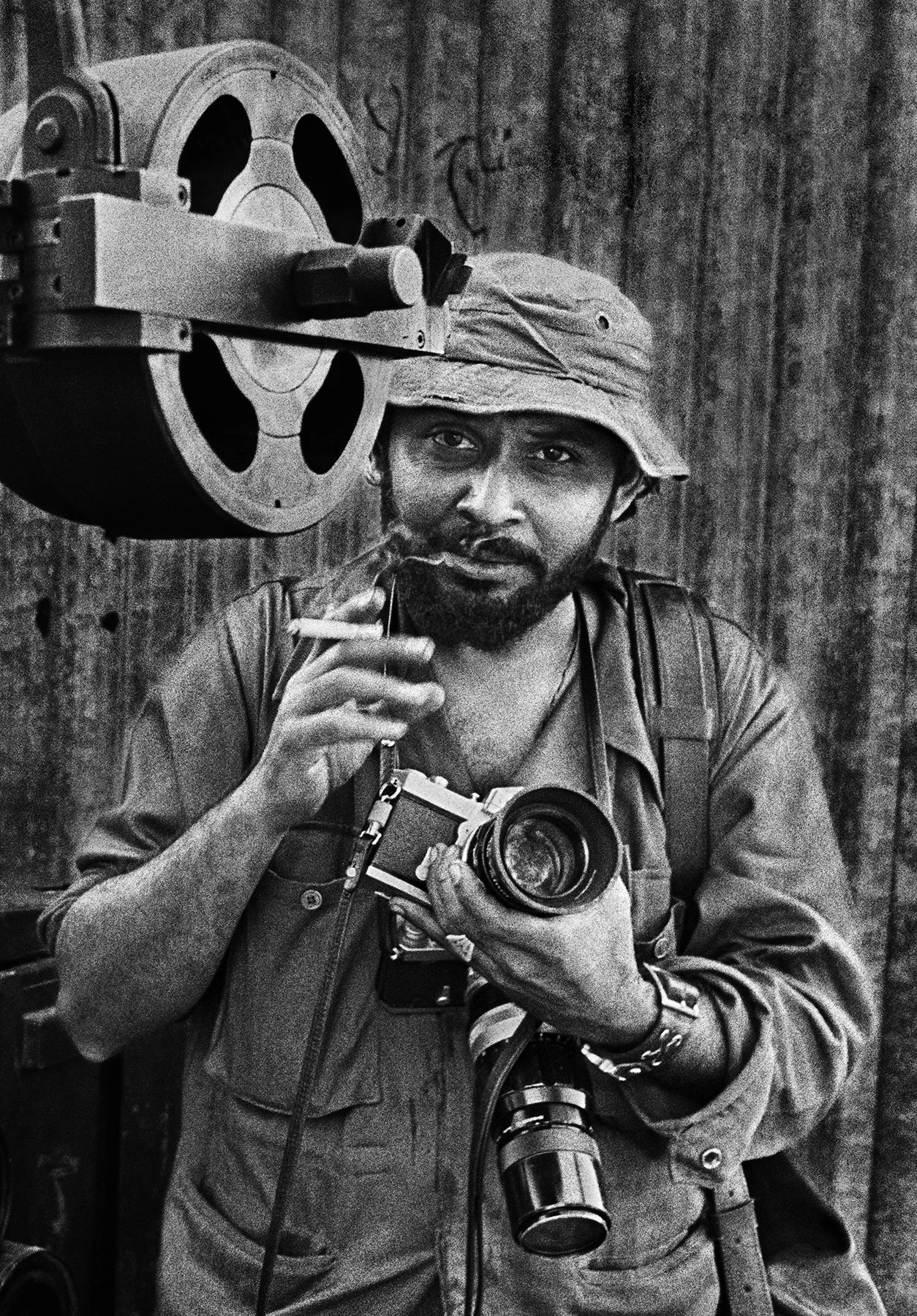
Kishor Parekh is one of India’s greatest photography legends.
News photography in India can be divided into two eras: pre-Kishor Parekh and post. In 1961, Parekh returned to India, armed with a degree in filmmaking and documentary photography from the University of Southern California. Such was his colossal presence that he had a radical impact from the very onset, introducing multi-column photos, full-page photo essays, and bylines for photographers, all of which were unseen in the Indian media until then. Never before had a photographer so altered the visual landscape of newsprint in India.
Beyond journalism, Parekh straddled the worlds of contemporary, commercial, documentary and art with fluid finesse. His work was groundbreaking, his contemporary approach, radical. His book Bangladesh—A Brutal Birth (1972) is one of the seminal works in Indian photobook history.
In 1982, Kishor Parekh died at the Valley of Flowers, where he was working on what would have been his third book. He was only 52. A few days before his death, while soaking in the beauty of the valley, Parekh told his best friend with typical candour “…what a place to die yaar!” A man who had chronicled the edges of life and death almost preempted his own. As a massive heart attack battled him, he calmly kept his beloved Nikon F2 on the ground and laid with it one last time.
His coverage from India found acceptance in a wide range of international publications, including National Geographic, Paris Match, London Times, TIME magazine, Newsweek, Stern, Popular Photography and Asahi Graphic. Between 1967 and 1972, Parekh worked with Asia Magazine and as the Picture Editor of Pacific Magazines Ltd, based out of Singapore and Hong Kong. Through the 70s, he worked out of Bombay, bagging numerous accolades for his fashion and commissioned work.
Kishor Parekh was a photographer, a documentarian, an artist and a fashion icon, all rolled into one inimitable persona. Charming, dynamic and stylish to the core, Kishor’s magnetism had an unequivocal lure.
Live, Love, Experience. That’s how Kishor lived. And that’s how Kishor died.
Prominent Practitioners Remember Kishor Parekh
S Paul, Photographer & Dear Friend:
“Parekh was Parekh, the ultimate. Greatest photographer, greatest human being, greatest friend. That’s what I would call him. Bahut pyara aadmi tha (he was a very lovable person). Transparent like a sheesha, and honest. Whatever was inside would reflect on the outside. It would show through his eyes. He had eyes that could attract anybody. And those eyes showed that he was a great artist.
His contribution to photojournalism in India completely changed its definition. He revolutionised newspaper photography by introducing the 35mm format, multi-column pictures & photo essays. The bylines that photographers take for granted today, are because of him and him alone. Usne photojournalism mein aisa dhamaaka macha diya. (He created an explosion in photojournalism)
He died too young. I miss my friend a lot.”
Raghu Rai, Photographer & Dear Friend:
“Kishorbhai was an explorer. A mad explorer. He was ready to take on anything with the might and strength of his camera. At the point of shooting, he wouldn’t care about anything else. And that’s what I, too, learnt from him.
He was a warm, handsome and affectionate guy. And he was open. What was going on within him would show on his face through his big eyes. I was with Kishor when some of these iconic photographs were taken, but somehow, it was something that only he managed to capture... to be able to project life as it is, in its essence, you need not just sensitivity but the art of reaching out and touching the truth. Kishor Parekh had this.”
Richard Bartholomew, Art Critic & Photographer:
“Kishor was perhaps the best known photographer in Asia. His photographs portray thousands of significant moments, which together, comprise a collective visual memory... he opens our eyes—our inner eye—to a reality which is a revelation.”
N Thiagarajan, Photographer:
“Photographers should erect a statue for Parekh. He came to India and completely changed the style of Indian news photography. But it wasn’t easy. He fought for it."
S K Chadha, Photographer & Dear Friend:
“He was a down-to-earth Guru. He was very powerful in every way. He had unmatched personality, knowledge, experience and the lust to work. Boss aadmi tha, bilkul boss.
His death was a big loss to Indian photography.”
Jyoti Bhatt, Artist, Photographer & Dear Friend:
“Apart from introducing the 35mm format here, he also introduced Indian photo-journalists to the eloquent use of what I call, the ‘wise-angle lens’. A poignant use of the wide-angle lens. Many good photographers today are what they are, because of Kishor.
Personally for me, he was instrumental in taking my eye away from the easel and into the viewfinder.”
Swapan Parekh, Son & Photographer:
”A mix of Prince Henry tobacco from his perpetual companion, the pipe, and musky Tabac cologne, I remember my stylish father by that fragrance.
Whatever he did, he did with all heart. Whether it was his love for his friends, cuddling us kids, dancing, playing cricket, eating roadside pani puri, glugging his beer, playing his hand at teen patti, listening to his favourite tunes—from The Beatles to the Gujarati Dairo (colloquial song)—or when he cried like a baby... he did it with all his being. I believe it was this sheer indulgence of life that blended into oneness, each time he pulled the trigger of his beloved Nikon.
As a son and a photographer, Dad, it has been tough leading a life without you.”